Splitting Wood With an Axe Safely: Essential Tips for Every Homeowner
Splitting your own firewood is satisfying work, especially when a well-placed strike opens a round cleanly.
Safe wood splitting with an axe depends more on control, the right tool, and a stable setup than on brute strength.
You don’t need to strike harder every time the wood resists, because stubborn wood fibers, an unstable round, or an unsuitable axe can turn extra effort into a dangerous miss.
When you prepare to chop firewood safely, take a few minutes to organize your space to make the work less tiring and give you a clear place to stop between strikes.
Start with manageable wood and a clear work area, then prioritize safety over finishing the pile.
Key Points
- Choose a splitting axe for manageable rounds, and switch to a heavy maul when larger or knotty wood resists.
- Wear personal protective equipment, including eye protection, well-fitting gloves, and protective-toe work boots, and inspect the axe before starting.
- Stand each round on a stable chopping block, keeping people and loose objects out of the work area.
- Follow existing cracks, maintain a balanced stance, and guide the axe rather than forcing each strike.
- Stop when the axe sticks, your aim slips, or fatigue makes the next strike uncertain.

- MULTI-USE AXE: Sharp blade axe is an ideal wood chopper designed for firewood, yard work, and lawn cleanup, with maximum efficiency for more one-strike splits; Perfect for medium to large size logs
- EFFICIENT AND COMFORTABLE USE: Shock-absorbing handle with textured non-slip grip reduces hand strain, improves control, and prevents overstrike damage; 36″ handle is ideal for taller users
- LONG-LASTING AND RELIABLE: Hardened forged steel blade stays sharper longer than traditional axes and advanced bevel convex design splits efficiently and makes the blade easier to remove from wood; Provides excellent durability and lasting value
- QUALITY OUTDOOR TOOLS: Designed to help you embrace the outdoors, Fiskars axes and hatchets are equipped with smart technologies and award-winning, ergonomic features that make it easier to tackle outdoor tasks; Ideal gardening gifts for the holidays
- INCLUDES: 1 Fiskars Super Splitting Axe with protective sheath; Backed by a lifetime warranty

Last update on 2026-10-27 / Affiliate links / Images from Amazon Product Advertising API
Choose the Right Axe and Prepare a Safe Work Area
A splitting axe has a thicker, tapered head that pushes wood fibers apart. A felling axe has a thinner profile suited to cutting across wood fibers.
Popular options like a Fiskars splitting axe feature molded composite handles and optimized head geometry designed to prevent sticking.
Choose a tool you can lift and guide comfortably. A heavier head won’t help if it pulls you off balance. For very large or knot-filled rounds, a maul and wedge are often a better choice.
Wear eye protection, gloves, and sturdy boots
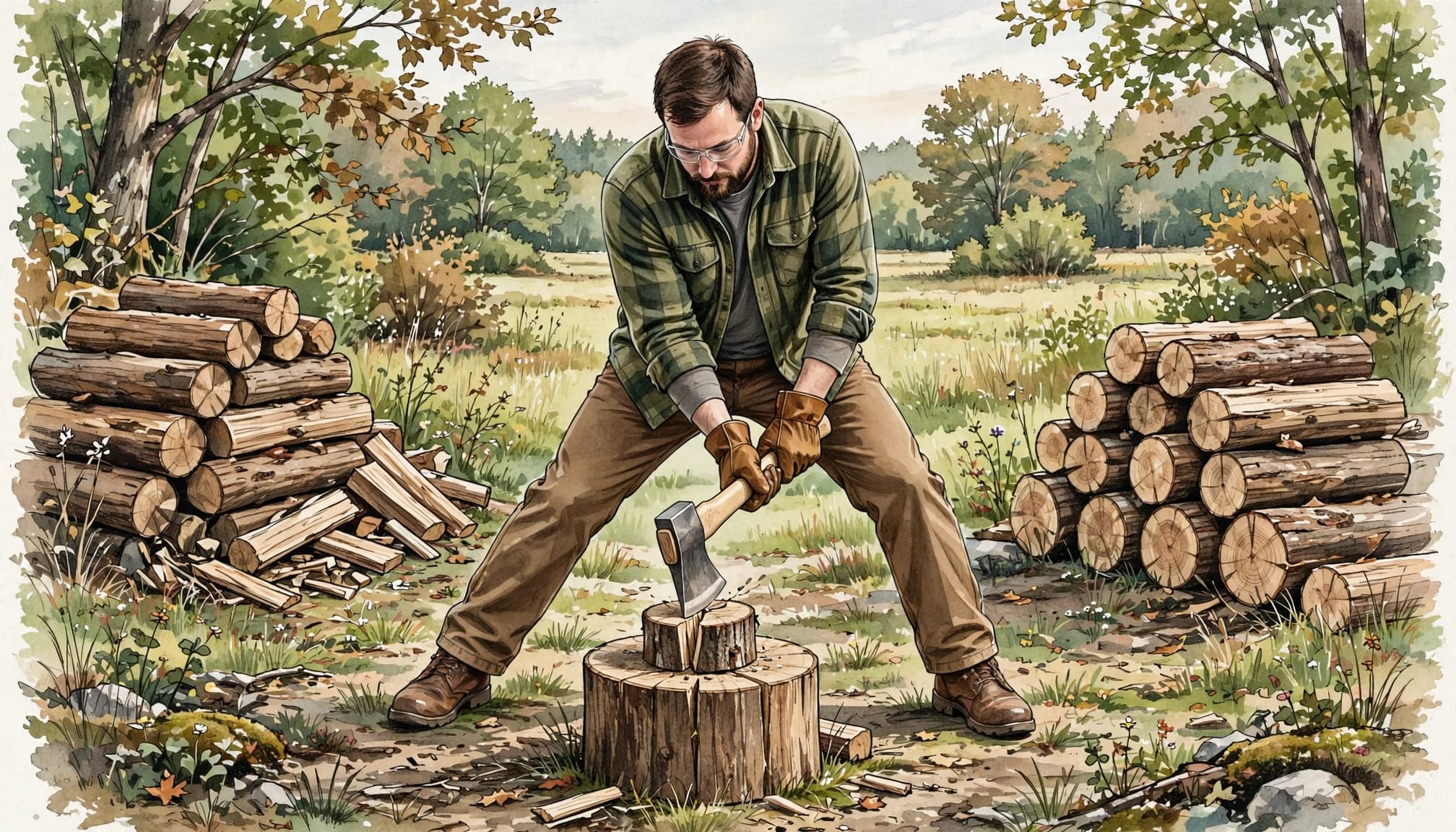
Wear safety glasses or goggles to protect against flying chips. Well-fitting gloves improve grip and protect your hands from rough bark and splinters.
Choose sturdy work boots with protective toes and dependable traction. They help if you drop wood, but they won’t make an axe strike safe.
Before starting, inspect the handle for cracks, splinters, or other damage. The head must be firmly attached. Stop if anything is loose or damaged.
Have another adult nearby when possible, but warn everyone to stay outside the work area. Keep a phone accessible for emergencies.
Set the round on a stable chopping block
Choose level ground with enough room for the entire swing and overhead clearance. Remove loose splits, branches, and anything that could trip you.
Use a broad, solid chopping block that doesn’t rock. Stand a manageable round or log upright on a flat end. Never hold it steady with your hand while swinging.
Position the round toward the far side of the block, leaving wood beneath the likely path of a missed strike. Keep your feet outside that path.
The block reduces risk, but it can’t guarantee a safe miss. If the round wobbles, reposition it before lifting the axe.
How to Split Wood With an Axe Safely
Practice with straight-grained rounds before tackling difficult wood. Reset your stance and target between strikes rather than swinging repeatedly without looking.
Read the grain and choose a starting point
Look at the end grain for existing checks or cracks. Aim along one of those openings so the split follows the fibers.
A crack near the pith, the small center where growth rings begin, offers a useful starting line. Avoid aiming through a knot, where grain changes direction.
For wide, stubborn rounds, use the two-cut method. Strike opposite outer edges first to relieve perimeter tension, then split down the center.
Grip the handle with control
Use both hands. Place your lower hand near the handle’s end and your upper hand closer to the head.
As the axe descends, let the upper hand slide toward the lower hand. Keep a secure grip without squeezing so hard that your arms become stiff.
Stand balanced and guide a straight swing
Stand with your feet about shoulder-width apart and your weight balanced. Keep your legs outside the blade’s potential landing path.
Lift only as high as you can control comfortably. Guide the head straight toward your chosen point without lunging, overreaching, or turning sideways. A sharp blade cuts cleanly rather than glancing off the wood.
Follow through without forcing the strike
Let the axe’s weight carry it into the round while your hands guide its direction. Accurate placement matters more than maximum effort.
Avoid twisting hard at impact. Sideways force can stress the handle, especially when the edge has already caught in the wood.
Stop safely if the axe gets stuck
Keep the round supported and don’t jerk or wrench the handle. If a gentle pull along the entry direction doesn’t release it, stop.
The Forest Service’s stuck-axe guidance describes freeing a trapped axe by splitting the round with other suitable tools. Seek experienced help rather than lifting or swinging an awkward, attached round.

- MULTI-USE AXE: Sharp blade axe with inseparable riveted head is an ideal wood chopper designed for firewood, yard work, and lawn cleanup, with maximum efficiency for more one-strike splits; Perfect for medium to large size logs
- EFFICIENT AND COMFORTABLE USE: IsoCore shock-absorbing handle with textured non-slip grip reduces hand strain, improves control, and prevents overstrike damage; 36″ handle is ideal for taller users
- LONG-LASTING AND RELIABLE: Steel blade stays sharper longer than traditional axes while advanced blade geometry splits tough logs efficiently and makes the blade easier to remove from wood; Provides excellent durability and lasting value
- QUALITY OUTDOOR TOOLS: Designed to help you embrace the outdoors, Fiskars axes and hatchets are equipped with smart technologies and award-winning, ergonomic features that make it easier and more enjoyable to tackle outdoor tasks
- INCLUDES: 1 Fiskars IsoCore Wood Splitting Maul with protective sheath; Backed by a lifetime warranty
Last update on 2026-10-27 / Affiliate links / Images from Amazon Product Advertising API
Make Firewood Easier to Split and Safer to Handle
Wood condition affects your results as much as technique. Choose rounds that suit your tool and strength, rather than treating every piece as a challenge.
Split seasoned rounds and work around knots
To split firewood efficiently and safely, choose rounds that match your tool and physical capability.
Some rounds split more easily after partial drying because checks open along natural fiber lines. However, species differ, and many woods also split well while green.
Dense hardwoods like oak generally split cleaner when seasoned, while fibrous softwoods often separate more easily while green.
Follow visible cracks when they’re available. On knotty rounds, remove smaller slabs around the outside rather than trying to drive straight through the knot.
Stop if the round becomes unstable as its shape changes.
Cracks don’t prove that firewood is ready to burn. Newly cut wood still needs drying time after splitting, and the timing depends on species, weather, and storage.
Stack finished pieces off the ground in a well-ventilated woodstack with ample airflow. Before burning your supply in a wood stove or fireplace, include screens, doors, and nearby combustibles in your fall fireplace maintenance.
Know when to switch to a maul and wedge
Repeated bouncing, deep sticking, or little progress means it’s time to reconsider the tool. Don’t compensate with an uncontrolled strike.
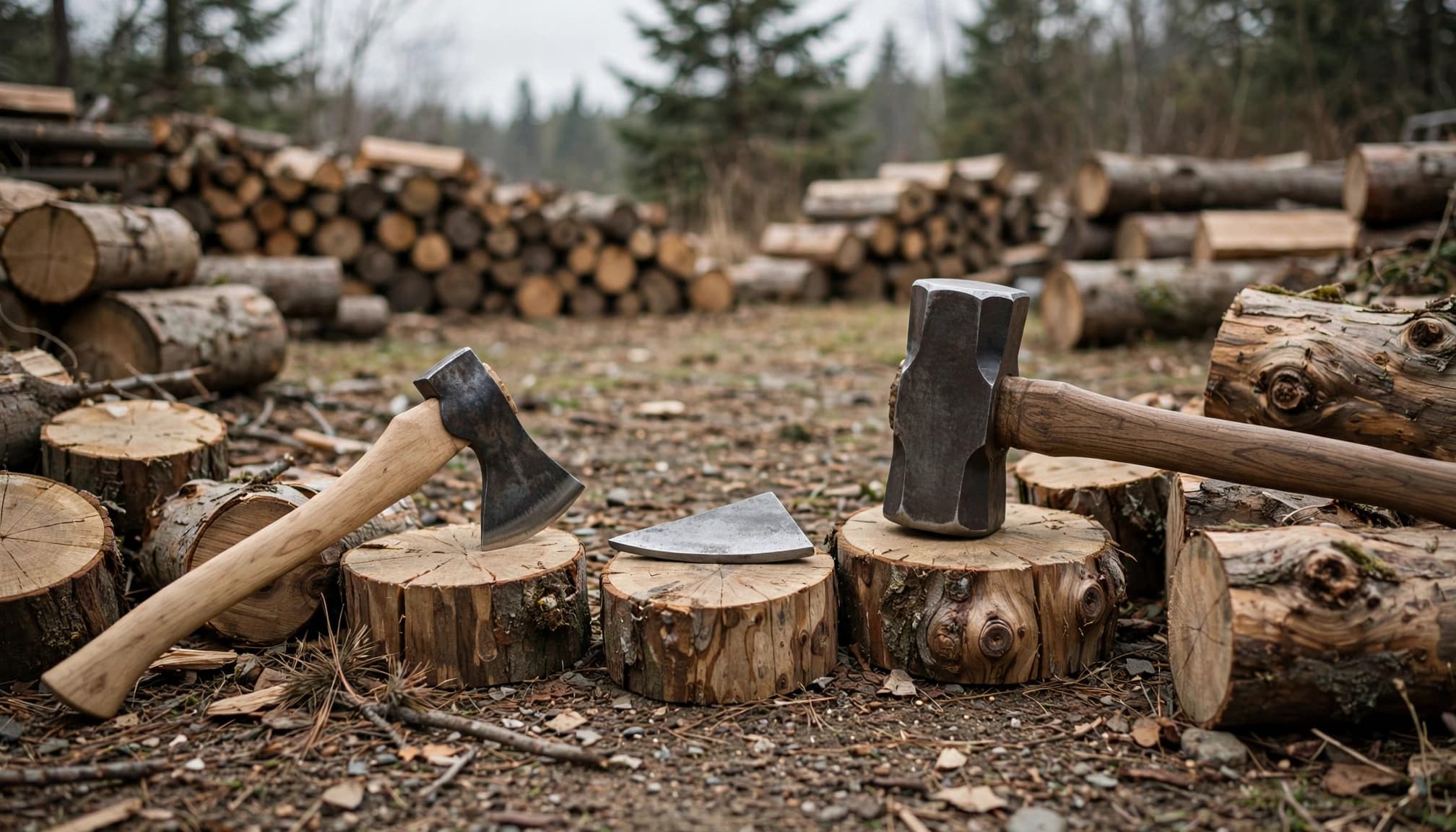
A splitting maul combines a heavy head with a broad wedge profile. A separate splitting wedge can help open stubborn rounds when driven with a tool designed for that purpose.
An ordinary axe poll isn’t a sledgehammer. Unless the manufacturer designed and rated it for striking steel wedges, don’t use it that way. Many axe polls aren’t hardened for that work and can deform or suffer damage.
Inspect steel striking faces and driving tools before use, too. Mushroomed or chipped striking surfaces need attention before another blow.
If the required tools feel too heavy, leave that round for experienced help or an appropriate splitter.

- 【Sturdy and Durable】: Heavy Duty Wood splitter blade is made of Cast Iron,One-piece molding, No welding,Not easy to break,Surface pattern design is more beautiful and attractive,Coated with environmentally friendly paint,Can effectively prevent rust,Which is more sturdy and durable,Blade is equipped with a rubber sleeve,Safer compared with exposed tools and also has enhanced anti-accidental touch performance.
- 【Convenient and effortless to use】: kindling splitter base plate is equipped with screw holes for easy fixation on wood, tree stumps and other materials.This enhances stability and elevates the cutting height,Axe-shaped cutting edge is adopted, Which makes the operation more effortless compared with the flat cutting edge.Also equipped with a 3-pound Rubber Hammer for assistance.Bonus 4x installation screws making it more convenient and worry-free to use.
- 【Size and Design】: Kindling splitter weighs 10.5 pounds, Stands 12.2 inches tall, There is enough height to split the firewood,features an open style blade design with no obstruction. Back of the blade is thickened multiple times,Integrated design makes it more sturdy and durable.
- 【3 LB Dead Blow Hammer】The outer layer of the hammer is made from a one piece of thickened rubber, which effectively protects the blade of the Kindling splitter when striking a log, preventing damage to the blade. The middle layer features a high-quality, thickened steel structure, making it even more robust and durable, whilst the interior is filled with shockproof steel balls, which provide additional force during the strike and eliminate rebound
- 【Wide Range of Uses】: Heavy Duty Wood splitter is the best tool and helper for storing firewood in your backyard during winter,providing good matches for fireplaces, camping, barbecues,stoves,saunas,etc.Kindling splitter Suitable for use with dry logs,cannot be used with wet logs.
Last update on 2026-10-27 / Affiliate links / Images from Amazon Product Advertising API
Frequently Asked Questions
How sharp should a splitting axe be?
The edge should bite cleanly into wood without needing a razor-like finish. Keep its intended bevel rather than grinding it thin.
The Forest Service’s axe-sharpening guidance explains how edge shape and the thicker head work together. A maintained edge is less likely to glance off.
Is an axe or a maul better for splitting firewood?
An axe is usually easier to control on manageable, straight-grained rounds. A maul offers more weight and a broader splitting profile for tougher pieces, while auxiliary splitting tools help open stubborn sections.
For processing smaller kindling, a lightweight hatchet is much safer and more maneuverable than a full-size splitting axe. Choose based on the wood and your ability to handle the tool, not weight alone.
Can I split freshly cut wood?
Yes, as long as the round is stable and manageable. Green wood can resist splitting, although some species split readily before they dry. Splitting exposes more surface area for drying, but freshly split wood still needs seasoning to burn cleanly in an open fire. No single drying period fits every woodpile.
What should I do if the axe misses the round?
Stop and let the axe come to rest before moving or trying again. Check your footing, the round’s stability, and the area beneath the target. Then reset your distance and aim. If misses continue, take a break rather than trying to correct them with stronger swings.
Can I split wood alone?
Having another adult nearby is a sensible precaution, especially while you’re learning. That person must stay outside the swing area and away from flying pieces.
Nobody should hold the round or collect splits while you’re swinging. If you’re alone, postpone wood that feels awkward or beyond your ability.
Build Control Before Adding Power
Safe, effective splitting starts before the axe leaves the block. Choose manageable wood, inspect your tool, and make sure you have solid footing and a clear landing area.
Then make each strike deliberate. Follow existing cracks, let the head do its work, and reset whenever the round shifts or the previous blow changes your target.
Treat fatigue as a stopping point, especially when your grip weakens or your aim becomes less consistent. Set a stubborn log aside instead of spending your remaining energy forcing it apart.
The pile can wait until you’re rested or have the right help.
Finishing fewer rounds with controlled strikes is a sound day’s work. It leaves you with reliable fuel for the fire.